

The North Bridge is one of Edinburgh’s most famous landmarks, an iconic structure built between 1894 and 1897. However, its history is more complex than it first appears. What many don’t realise is that the bridge we see today had a predecessor. Learn more at edinburgh-future.
The First Attempt
Work on the original bridge began on 21 October 1763. The project was the brainchild of the visionary Lord Provost, George Drummond. Its construction was linked to the draining of the Nor’ Loch, a body of water that had long formed a natural boundary between the city’s Old and New Towns.
Although the decision to build the bridge was made, the contract and all associated documents weren’t signed until 21 August 1765. The agreement was between the Edinburgh Town Council and the architect, with the project valued at £10,140. The works were scheduled for completion by 11 November 1769, and the architect was required to provide a 10-year guarantee on the quality of his work.
An Unforeseen Problem
However, the builders soon encountered a major, unforeseen obstacle. The northern slope of the hill where the Old Town stands is exceptionally steep. For centuries, earth and rubble from the foundations of new buildings had been simply tipped over the edge. As a result, the ground below consisted of a deep layer of loose, unstable soil. When it came time to lay the bridge’s foundations, workers discovered they needed to dig much deeper than planned, but the sheer volume of this dumped earth made the task incredibly difficult.
Disaster Strikes
This critical oversight, combined with other design flaws, led to disaster. On 3 August 1769, a section of the structure collapsed, tragically killing five people.
A Hefty Price
Rebuilding the structure required considerable funds. The bridge eventually reopened in 1772. Its final design consisted of a large central arch, flanked by smaller side arches and several hidden ones. Notably, in 1817, new buildings began to spring up on the streets running alongside the bridge, which soon created a need to widen the bridge itself.
The New Bridge
Much later, in 1894, plans were drawn up for a completely new version of the bridge. Although construction is often said to have started that year, the first foundation stone was not actually laid until 25 May 1896. The project was completed and celebrated with a grand opening on 15 September 1897. A commemorative coin depicting the bridge was even minted to mark the occasion.
Adornments and Surroundings
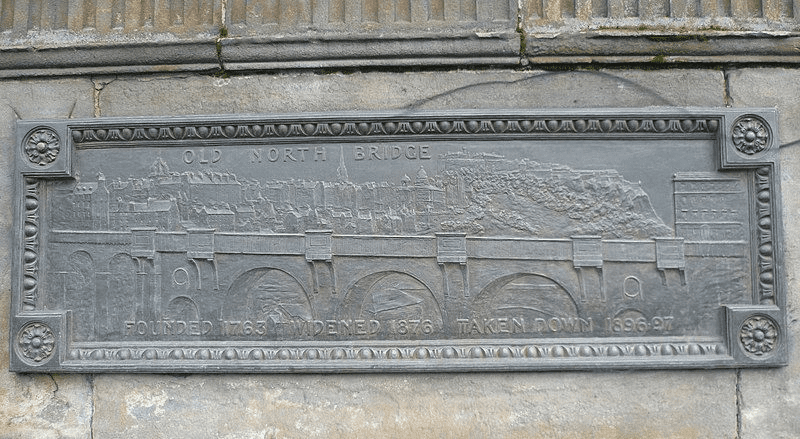
The new bridge is adorned with a war memorial, honouring the soldiers who died in various campaigns between 1878 and 1902. The bridge is surrounded by imposing architecture. The south side is flanked by impressive buildings with entrances directly on the roadway. On the west side stands the Scotsman Hotel alongside various commercial units. For many years, from 1906 to 1976, the east side was home to a large department store; after it closed, the building was converted into a hotel with smaller shops. Finally, the north end of the bridge is graced by the iconic Balmoral Hotel, originally known as the North British Hotel, which once served railway company staff.
Modern Refurbishment
The bridge’s story continues into the modern era. In 2021, it underwent a major refurbishment project. The initial plan involved replacing the paving and kerbstones, upgrading the drainage and waterproofing, and renewing the reinforced concrete deck. The work was scheduled to take nine months. However, in the summer of 2022, it was announced that the project would be extended. The delay was due to the unexpectedly poor condition of the concrete in the central span.