

The core purpose of aviation infrastructure is to ensure every flight is safe and efficient. It stands to reason, as its key components—airports and airfields—play a vital role in modern passenger transport. Safety is therefore paramount. Read more on edinburgh-future.
This focus on safety extends to cargo flights. While the hold may be filled with goods rather than people, a human crew is still at the controls. A smooth, risk-free flight is essential. Furthermore, the cargo itself has significant value, representing a crucial investment for businesses. Ensuring its safe arrival is just as important.
When the Unexpected Turns to Tragedy
Unfortunately, operating aircraft does not come with an absolute guarantee of safety. Numerous factors come into play, with the airspace itself being a primary one. It is a dangerous and unpredictable environment, and an aircraft following its designated route can encounter sudden difficulties. Sometimes, these events lead to tragic outcomes: air disasters.
The Crash of the Short 360
Edinburgh’s history is not without its own aviation incidents, and sadly, some have had tragic outcomes. A notable example is the crash of a Short 360 near Edinburgh. This tragedy occurred on 27 February 2001. A Loganair aircraft was scheduled to operate a regular cargo service, Flight LC670A. However, just over ten minutes after the aircraft took to the skies, the unthinkable happened.
From a Normal Take-Off to a Mayday Call
To understand the disaster, we must revisit the events of that day. At approximately 17:10, the first officer requested clearance, and after a short delay, the crew taxied onto the runway. The take-off was normal, with no sign of the impending disaster. Even the power reduction at an altitude of 1,200 feet was standard procedure. As the aircraft climbed to 2,200 feet, the first officer activated the engine anti-icing systems, while the captain switched to a new radio frequency.
But just four seconds later, the engine instruments plummeted, and the aircraft lost all propeller thrust. While the first officer transmitted a Mayday call, the captain began a descent, reducing airspeed and turning right towards the coast.
An Inevitable Tragedy
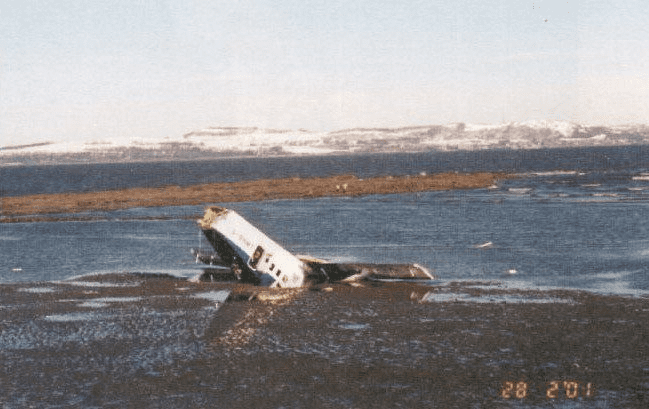
However, as they struggled to avert disaster, the crew realised they would not make it to the coastline. An emergency ditching was their only option.
The aircraft ultimately crashed into the waters of the Firth of Forth. It was later found 65 metres from the shore, resting nose-down at a 45-degree angle. The front half of the fuselage was submerged in approximately 6 metres of water, stuck fast in the sand.
The flight deck was almost completely destroyed. The tail section had broken off and was found floating 100 metres away from the main wreckage.
The Investigation and Initial Findings
Naturally, an investigation into the tragedy began immediately. The crash of the Short 360 had come as a huge shock, as there had been no warning signs. After examining the wreckage and thoroughly investigating the short flight, the Air Accidents Investigation Branch reached its conclusion.
The investigation pointed to a critical issue concerning the engine intake covers during adverse weather. The aircraft had landed at Edinburgh Airport around midnight during a snowstorm. It was then parked and remained exposed to strong winds and blowing snow for approximately 17 hours.
Snow Accumulation: The Root Cause
Because protective covers had not been fitted to the engine intakes, a significant amount of snow was blown inside. However, these intake covers were not part of the aircraft’s standard equipment, and none were available at Edinburgh Airport. Furthermore, the operating manual for the Short 360 lacked specific instructions for such freezing weather conditions, meaning the necessary precautions were not taken.
The investigation also determined that the snow had accumulated in an area where it could not be seen during the pre-flight inspection. During take-off, this build-up of snow and slush disrupted the airflow into the engines. This led to a ‘flameout’ in both engines when the anti-icing vanes were opened simultaneously, as per standard procedure.
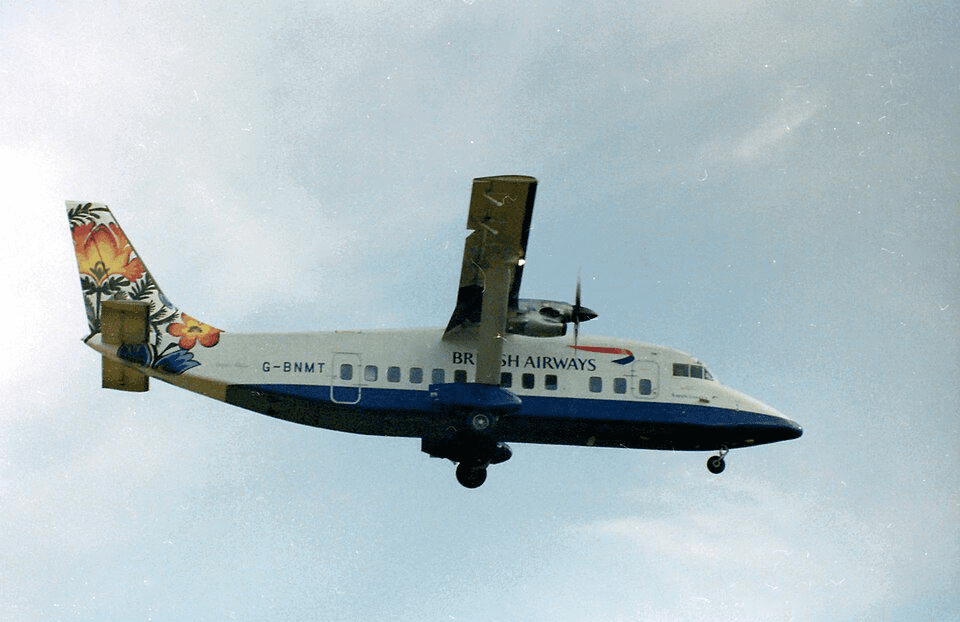
Investigators concluded that activating the anti-icing systems sequentially, with a time delay between each engine, would likely have prevented the simultaneous flameout of both engines.
In the wake of the crash, new safety recommendations were issued, and the aircraft manufacturer updated its operating procedures for sub-zero temperatures. But none of these changes could bring back the two crew members who lost their lives in the tragedy.
The bodies of Captain Carl Mason, 58, and First Officer Russell Dixon, 29, were recovered from the wreckage several hours after the crash.