

The Forth Bridge is one of Edinburgh’s most recognisable landmarks. Constructed between 1882 and 1890, it was immediately hailed as a monumental feat of 19th-century engineering. This was no surprise, as the project brought together the finest specialists and utilised the highest quality, most durable materials available at the time. Learn more at edinburgh-future.
Early Plans
A tunnel under the Firth of Forth was proposed as early as 1806, followed by a bridge design in 1818. However, both projects were rejected. It wasn’t until 1865 that an Act of Parliament finally approved the construction of a bridge.
In 1873, the engineer Thomas Bouch was commissioned by a consortium of four railway companies to design the crossing. He proposed a suspension bridge with two large spans. However, funding delays stalled the project, and only a single support pier had been erected by 1879.
The Tay Bridge Disaster
On 28 December 1879, work on the Forth Bridge was brought to an abrupt halt. The reason was the catastrophic collapse of the Tay Bridge during a violent storm—a structure also designed by Bouch. The disaster resulted in the tragic loss of 75 lives.
An official inquiry, which concluded in 1881, identified serious flaws in the bridge’s design. Consequently, the plans developed by Bouch for the Forth Bridge were immediately cancelled.
A New Design
Engineers Sir John Fowler and Benjamin Baker were subsequently tasked with creating a new design. They presented a cantilever structure, a project which Parliament approved in the summer of 1881.
Materials and Construction
To ensure its strength, steel produced in open-hearth furnaces replaced cast and wrought iron, offering significantly improved quality. Construction began in the winter of 1882, and by late 1885, the massive granite piers were in place, with eight of them standing in the water. The underwater foundations were prepared using caissons—enormous metal cylinders sunk to a depth of 27 metres.
A Crucial Stage
Work on the main superstructures began in 1886. This phase required a staggering amount of steel, exceeding 54,000 tonnes. The main span was finally completed on 14 November 1889, with some suspended sections floated into position.
Testing the Structure
On 21 January 1890, the bridge underwent rigorous testing. Two 300-metre-long trains were driven onto it. Each train, consisting of a 72-tonne locomotive and 50 wagons, weighed 900 tonnes in total. The tests were a success, confirming that all structural shifts were within acceptable limits.
The Grand Opening
The bridge was officially opened on 4 March 1890. The ceremony was even attended by the Prince of Wales. The total cost of the project exceeded three million pounds.
The Painting Problem
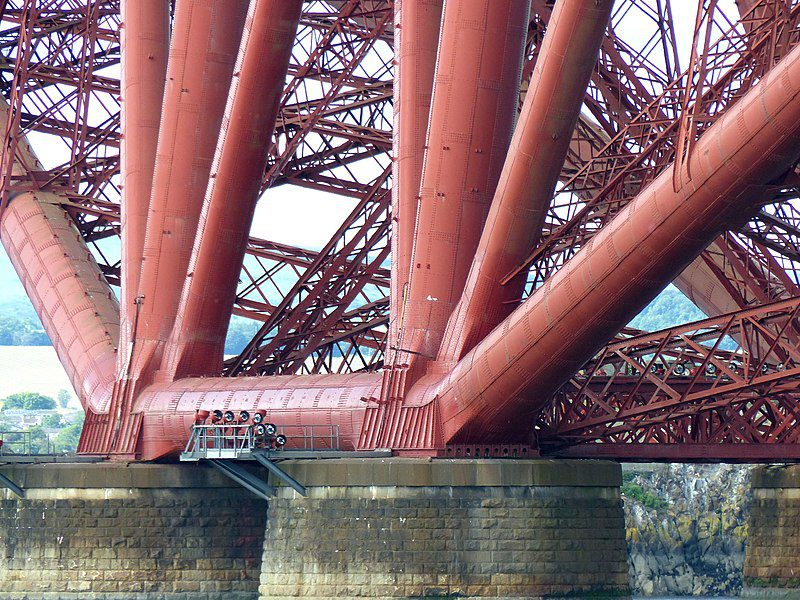
Interestingly, from the moment it was completed, the bridge was subject to continuous painting. The total surface area requiring this treatment was an immense 2.5 square kilometres. This meant that by the time the painters finished one side, the other was already beginning to show signs of rust.
Very quickly, the process of painting the bridge became famously known as a “Sisyphean task.” In 2012, this endless cycle was finally broken. Instead of conventional paint, a special long-lasting coating was applied, designed to preserve the pristine appearance of this famous structure for decades.