

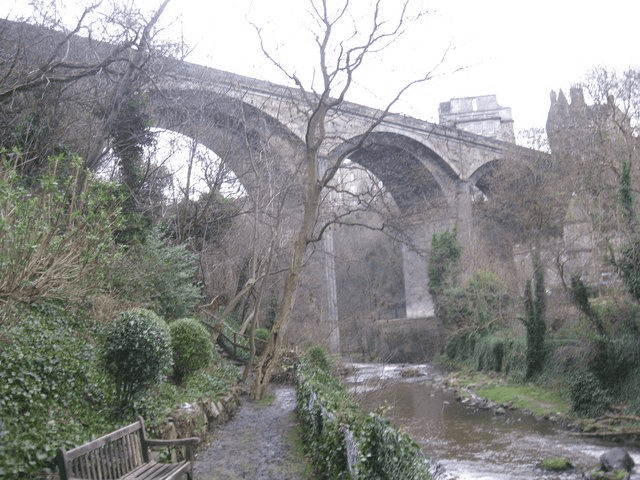
Dean Bridge spans the Water of Leith in Edinburgh. Edinburgh Future reveals more. Learn more at edinburgh-future.
The carriageway measures 447 feet long and 39 feet wide. It is one of the major structures designed by engineer Thomas Telford before his retirement. Construction was completed in 1831.
Background
From the medieval period onwards, the river was mainly forded. A single-arch stone crossing appeared later, but it could hardly be called a properly paved roadway.
The idea for a bridge
The proposal to build a proper, sturdy new bridge came from John Lermont, owner of the Dean estate on the north bank of the river.
A new plan
After the successful expansion of the New Town, Lermont saw an opportunity to sell his land and drive further growth. He wanted his estate to sit adjacent to a convenient route into the city.
John even offered to finance the project himself, pledging £18,556 towards construction.
However, in 1828, officials responsible for the county’s public roads proposed to share the cost of a new bridge. They insisted that John Gibb, Britain’s leading bridge engineer at the time, should handle the design.
Materials
Work began in 1829 and wrapped up at the end of 1831. Costs were cut significantly by hollowing out the bridge’s piers. This approach later made routine inspections and investigations much easier.
Craftsmanship
A pedestrian walkway was installed alongside the outer segmental arches. Wooden supports had to be removed with extreme caution. The process demanded meticulous attention to detail and high professional skill to ensure the bridge emerged perfectly level and stable.
Completion
Construction finished in 1831. Between the end of the build and the formal handover, Gibb succeeded in installing toll gates at each end of the bridge. Pedestrians had to pay for the privilege of enjoying the scenic views from atop the bridge.
Ceremonial opening
Although horses and carriages could only cross from May 1834, the official opening ceremony was held in early 1832.
Sudden death
Sadly, Lermont died in 1858 before he could witness the completion of all the works or see his grand vision realised.
Preventive measures
In 1888, the Edinburgh Corporation approached engineer John Cooper for recommendations to prevent suicides from the bridge. By that time, the structure had sadly become a frequent site for such tragedies.
Cooper recommended raising the height of the parapet. This solution was successfully implemented.
Stolen plaque
In 1957, the Institution of Civil Engineers affixed a bicentenary plaque to the bridge. The memorial was later stolen, but in 1982 it was successfully replaced.