

The Palace of Holyroodhouse is one of the true jewels in Edinburgh’s crown. Since the 16th century, it has served as the principal royal residence in Scotland, hosting various state occasions. Interestingly, the palace was originally built as a guesthouse for the adjacent Holyrood Abbey. Learn more at edinburgh-future.
From Abbey to Royal Residence
The story of this famous landmark begins in 1128 with the founding of Holyrood Abbey by order of King David I. The site soon evolved into an important administrative centre. In 1177, a papal legate was received there, and in 1189, a council of nobles convened within its walls. In 1579, James VI moved into the palace to begin his period of personal rule, and the building was restored at this time.
A momentous event took place at Holyroodhouse on 26 March 1603. It was within these walls that James VI received the news of Elizabeth I’s death and his accession to the thrones of England and Ireland. After ascending to the English throne, James moved south, and Holyroodhouse lost its status as a permanent royal residence. James himself would not visit the palace again until 1617.
Coronations, Conflict, and Reconstruction
In preparation for His Majesty’s visit, the Royal Chapel was reconstructed. In 1633, the west facade was repaired for the grand coronation ceremony of Charles I, who subsequently took up residence in the palace until November 1641. In 1650, the palace was severely damaged by a fire while it was occupied by Cromwell’s troops, after which a significant part of the residence was left abandoned.
The palace was restored again in 1660, regaining its status as a royal residence. In 1670, the Privy Council decided to completely rebuild the palace, but the grand modernisation was stalled by a lack of funds. Responsibility for overseeing the reconstruction eventually fell to the Lord High Commissioner, John Maitland, Duke of Lauderdale. After a lengthy approval process, construction finally began in the summer of 1671 and was gradually nearing completion by 1679.
Neglect and Revival
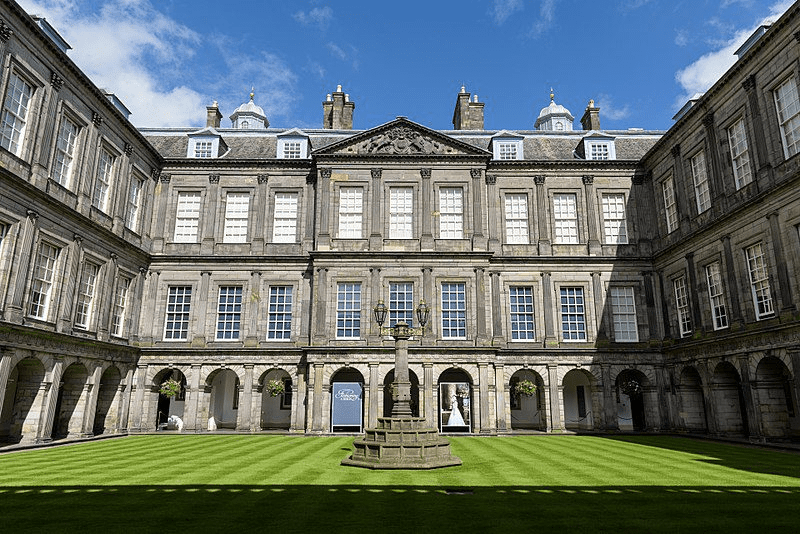
In 1707, with the Act of Union, the palace lost most of its primary functions. The first reigning monarch to visit the palace after Charles I was George IV, whose landmark visit took place in 1822. It was he who ordered the residence to be repaired. Extensive reconstruction work was carried out between 1824 and 1834, during which time several peripheral buildings were demolished and the southern facade was replaced.
Modern Comforts
The modern amenities found in the palace today are largely thanks to George V. He initiated the installation of central heating and electric lighting, as well as the modernisation of the kitchens and the creation of new bathrooms and a lift.